The promotional CD was made possible with the financial support of:
Douwe Kalma Foundation
Juckema Siderius Foundation
Ottema Kingma Foundation
Pollema Tromp Foundation
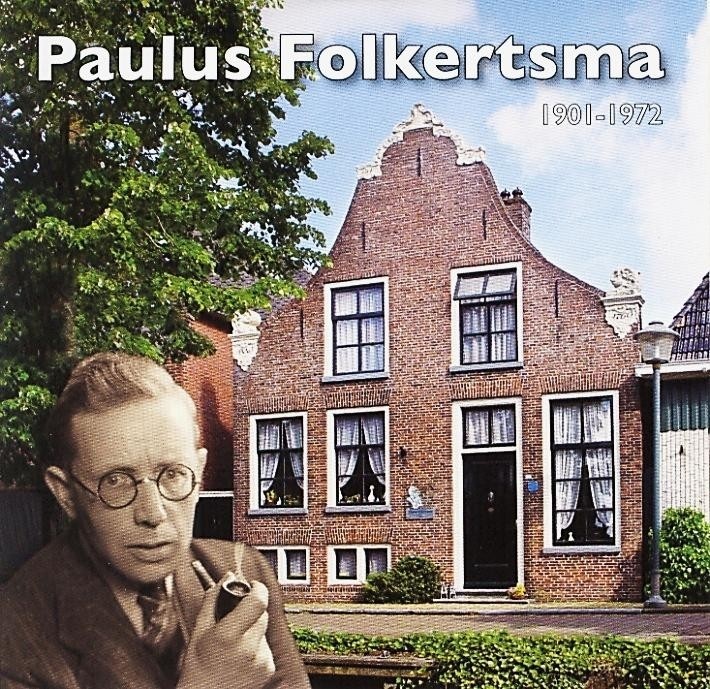
Paulus Folkertsma and his home on the Weaze in Aldeboarn.
Paulus Folkertsma (1901-1972) spent most of his life as a schoolteacher in the Frisian town of Aldeboarn. A self-taught composer, he left behind 77 official opus numbers; however, the actual number of his compositions exceeds one hundred. These include organ works, songs, symphonic works, cantatas, operettas, and chamber music. This promotional CD provides an overview of his diverse oeuvre.
Click on the titles to listen to the excerpt.
From: “Wer binn’de fjilden grien”
World War II deeply affected Paulus Folkertsma. Many of his compositions reflect this. The cantata “Wer binn’ de fjilden grien,” Op. 52, for choir and orchestra, dates from 1949 and is set to texts by the Frisian poets Douwe Tamminga and Fedde Schurer. The ease with which he writes for this instrumentation is striking. The result speaks for itself: intriguing orchestral introductions, melodious music for the choir with generously applied, ingeniously written modulations.
Ad hoc orchestra conducted by Harm Witteveen, Klaske Folmer (declamation)
From the CD Paulus Folkertsma, VPRO CD 014, 1992
Folkertsma’s most profound work is undoubtedly the 1943 string quartet “In memoriam R.O. Blackhall, A.J. Sutton, K.E. Emmons,” composed in memory of three crew members of a Royal Canadian Air Force Halifax bomber who perished in a crash on May 5, 1943, near Aldeboarn. It is a particularly concentrated work in which Folkertsma combined all his harmonic inventiveness and contrapuntal skill, placing them at the service of a moving depiction of the spheres. The invention alone is unique. An anapest, in which the thesis is always a minor third below the arsis notes, serves as the leitmotif. In a single, sustained movement, a thrilling climax is reached through contrapuntal intricacies and striking harmonies, after which the tension dissipates quite naturally. The ending is achieved through a highly inventive final cadence in which a whole-tone sequence plays a prominent role for the lower voice.
The Hathor String Quartet
From the CD Paulus Folkertsma, VPRO CD 014, 1992
From Piano Sonata Op. 57 No. 2
Johan Bijhold (piano)
From the CD “Mimerij”, Hecro HRCD030202, 2001
From “Sonata foar fioele en piane yn d” Op. 46
Jan Hulst (violin), Cees Steinroth (piano)
From the CD Paulus Folkertsma, VPRO CD 014, 1992
In Paulus Folkertsma’s oeuvre, the cantata “Mei snare en tonge” occupies a special place. Folkertsma himself called this work “the best thing I have ever written”. It is therefore incredibly unfortunate that the sheet music was lost over time. All that remains is a choral score and a cassette tape containing a recording of this work from a performance on June 27, 1966, in St. Martin’s Church in Bolsward by the Frysk Orkest and choirs from Bolsward, Sneek, and Grou, conducted by Bram Feenstra.
With this material, Johan Bijhold attempted to reconstruct the work. He listened to the tape almost measure by measure and transcribed what he heard. From the outset, it was emphatically not his intention to preserve the original instrumentation; out of respect for Folkertsma’s composition, he preferred to create an arrangement for choir and string quartet. Reconstructing such a complex composition in this way is a monumental task, and the musician Bijhold has accomplished a truly remarkable feat. We are especially grateful to him for it. Thanks to this performance, it is now possible once again to experience Folkertsma’s final work.
It Nije Ensemble conducted by Hoite Pruiksma
Live recording of a concert on October 24, 2009, in the Grote of Jacobijnerkerk in Leeuwarden.
From “De Jonkerboer” Op. 50
“De Jonkerboer” is an opera in two acts, written in 1944. The librettist, Dr. IJpe Poortinga, based his libretto on a story from the “Rimen en Teltsjes” by the 19th-century writer Dr. Eeltsje Halbertsma. Folkertsma composed this work for a large ensemble with soloists, choir, and orchestra. The arrangement is by Johan Bijhold.
It Nije Ensemble conducted by Hoite Pruiksma
Live recording of a concert on September 28, 2008, at St. Peter’s Church in Grou.